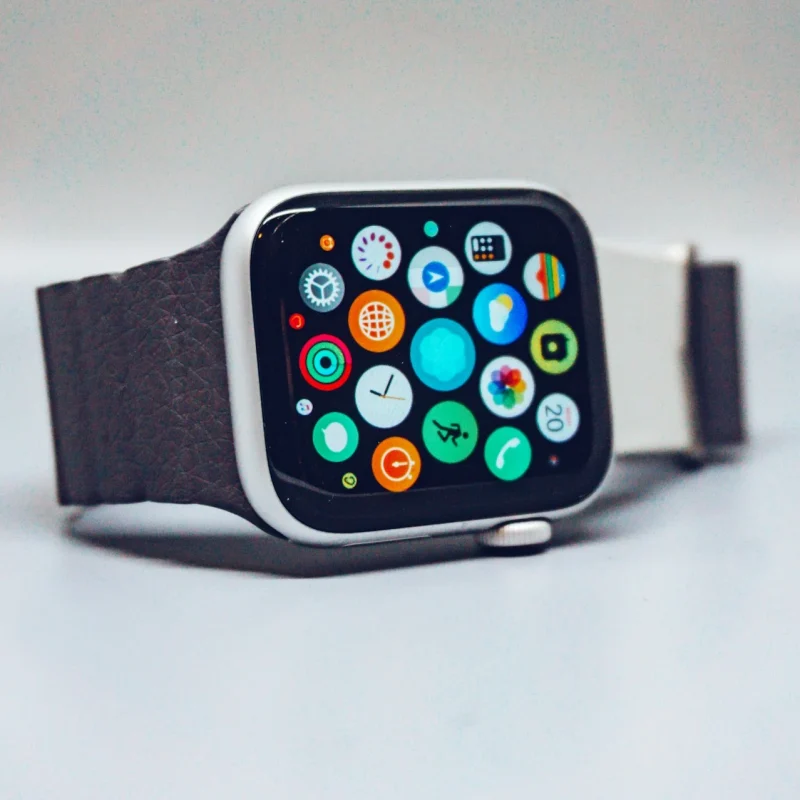
KineticOne came out of the running-watch world and it shows. The Surge brings the kind of running dynamics you only used to get from dedicated devices - vertical oscillation, ground contact time, stride length - in a watch slim enough for daily wear.

KineticOne Surge Pricing Options
KineticOne Surge
Compared across 3 retailers. Last checked May 18, 2026.
KineticOne Surge Ratings
-
Fitness Tracking4.9 /5
Running metrics are class-leading.
-
Display & Build4.5 /5
1.3" AMOLED in a stainless steel case.
-
Smart Features4.2 /5
Music and notifications, but no NFC.
-
App Ecosystem4.3 /5
Strong fitness apps, weaker general selection.
KineticOne Surge Pros & Cons
-
Running dynamics that rival dedicated GPS watches
-
Race predictor came within 9 seconds of our 10K time
-
Adaptive training plans included free
-
Comfortable enough to wear during sleep tracking
-
Cycling features feel underbaked next to running
-
Limited watch face customization
-
No NFC payments
KineticOne Surge Features
-
Heart rate monitor
Optical HR with running-cadence pairing.
-
SpO2 sensor
On-demand only.
-
GPS
Multi-band GPS with GLONASS and Galileo.
-
Sleep tracking
Includes the new KineticOne recovery score.
-
Music storage
8 GB, Spotify and Deezer offline.
-
Water resistance
5 ATM, suitable for swimming.
-
ECG
Not offered.
-
NFC payments
Planned for the next generation.
-
LTE/Cellular
Not available.
-
Voice assistant
Not supported.
KineticOne Surge Specifications
- Display
- 1.3" AMOLED, 1,000 nits
- Case material
- Stainless steel
- Battery life
- 9 days (smartwatch) / 30 hours (full GPS)
- Charging
- Magnetic cable, 0-100% in 90 minutes
- Connectivity
- Wi-Fi 5, Bluetooth 5.0, ANT+
- Weight
- 47 g (case only)
- Compatibility
- iOS 15+ and Android 10+
- Storage
- 8 GB
- Sensors
- Optical HR, SpO2, barometric altimeter, accelerometer
- Water rating
- 5 ATM

Fitness Editor
Felix reviews smartwatches the way other people use them - for weeks at a time, in the field, against real reference equipment. A former sports science researcher turned consumer-tech writer, he treats every review as a comparison study: GPS tracks logged against a dedicated Garmin, heart-rate readings cross-checked with a chest strap, sleep data sanity-checked against a polysomnography device borrowed from a sleep lab. He cares less about which watch has the longest spec sheet and more about which one survives an actual marathon training block. He's been on the same wrist size for 35 years.